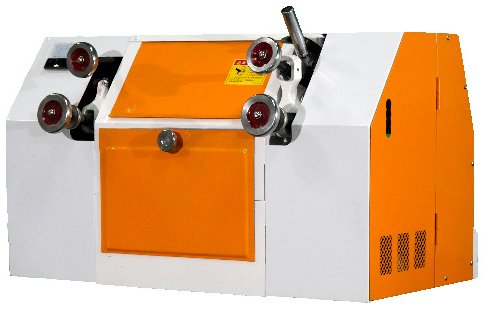
Grinding · Model 6F
6F Single Roller Mill
The building block of every small and medium flour plant.
- 60+ years manufacturing
- 10–500 t/d capacity range
- 100+ patents
- Turnkey commissioning
What it does
The 6F range is the single-roll unit from which most Haiyun plants are assembled. Roll diameter and length determine capacity; drive type determines maintenance; feed arrangement determines how many parallel streams one stand can serve. Understanding these three choices is most of what selecting a roll stand requires.
Technical parameters
Nominal values at standard conditions. Confirm final specification on the order drawing.
| Model | Roll dia. × length | Drive options | Feed options | Power | Weight | Dimensions (m) |
|---|---|---|---|---|---|---|
| 6F2560 | Φ250 × 600 | Belt / chain | Single / double | 7.5–15 kW | 1,000 kg | 1.14 × 0.78 × 0.67 |
| 6F2550 | Φ250 × 500 | Belt / chain | Single / double / triple | 7.5–11 kW | 900 kg | 1.04 × 0.78 × 0.67 |
| 6F2540 | Φ250 × 400 | Belt / chain | Single / double | 7.5–11 kW | 800 kg | 1.04 × 0.78 × 0.67 |
| 6F2250 | Φ220 × 500 | Belt / gear | Single / double / triple | 7.5–11 kW | 540–560 kg | 0.97 × 0.7 × 0.59 |
| 6F2240 | Φ220 × 400 | Belt / gear | Single / double | 5.5–7.5 kW | 460–480 kg | 0.87 × 0.7 × 0.59 |
| 6F2235 | Φ220 × 350 | Belt / gear | Single / double | 5.5–7.5 kW | 420–440 kg | 0.82 × 0.7 × 0.59 |
Selection guidance
Synchronous belt drive transmits more torque at low speed and is quieter; chain drive tolerates heat and dust better and is easier to repair with basic tools. In dusty environments with unskilled maintenance, choose chain and accept the noise.
Maintenance
Roll re-fluting every 1,500–2,500 operating hours depending on wheat hardness. Worn flutes polish the bran instead of cutting it, which floods the patent stream with fine bran.
Selection cross-check
Roller mills: single vs double
The roll mill is 55–65% of plant power and the machine that sets your extraction. The single/double choice drives the whole building layout.
This machine
6F Single Roller Mill
6F
Choose it when
Plants under 20 t/d, village mills, and anywhere the flow sheet has one or two passages. Simple, cheap, easy to maintain without specialist skill.
Watch out for
One pair of rolls per machine means one passage per machine — a 4B5M flow sheet would need nine separate mills and nine feed systems.
Alternative
FMFQ(S) Double Roller Mill
FMFQ(S)
Choose it when
Every plant above 20 t/d. Two independent roll pairs in one frame with separate feeds, so one machine serves two passages — which is what makes a compact multi-passage flow sheet possible.
Watch out for
Higher capital per unit and it needs proper foundation and alignment. Also grinds maize, sorghum, chilli and feed materials, so it is the flexible choice for multi-product plants.
Open FMFQ(S) Double Roller Mill →Decision rule
Under 20 t/d and two passages: single. Above that: double, without exception — the building savings alone justify it.
Answers
Frequently asked questions
Straight answers to the questions engineers and mill owners actually ask us during plant sizing. If your case is not covered, send the wheat specification and your target tonnage.
Ask an engineer →- What does "single" and "double" feed mean?
- Single feed means the stand serves one grinding passage. Double feed means two separate product streams can be fed to the same roll pair from either end — effectively doubling useful capacity on a stand.
- How often do rolls need re-fluting?
- Every 1,500–2,500 hours. Hard wheat and high extraction accelerate wear. Re-fluting costs far less than the losses from a dull roll, so most mills schedule it rather than wait for symptoms.
- Belt or gear drive?
- Belt: smoother, quieter, easier to align, needs tension checks. Gear: compact, no slip, better at very low speed, but needs an oil bath and is unforgiving of contamination.
From the brochure
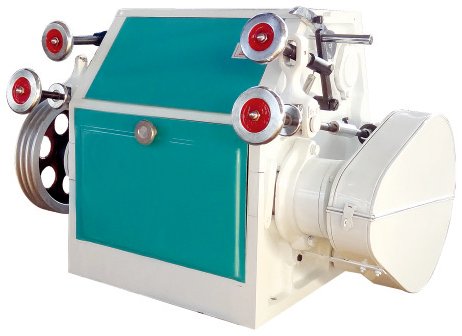
6F Single Roller Mill catalogue images
Photographs and parameter panels reproduced from the 2026 catalogue. Captions are the original brochure text.
Next step
Send your tonnage. Get a flow sheet in 12 working hours.
Send us: daily capacity target, wheat type and quality, available building dimensions, and local power supply. We reply within 12 working hours with a preliminary flow sheet, equipment list and budget range — no obligation.