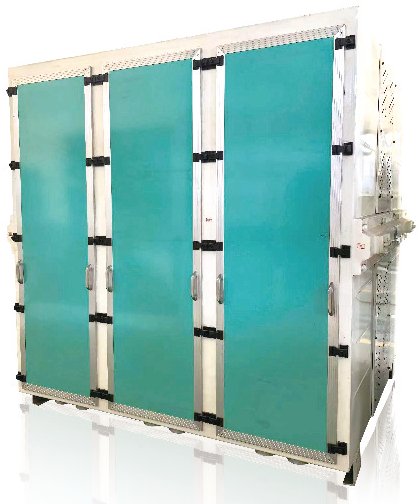
Sifting · Model FSFG
High Square Plansifter
Four, six or eight isolated bins — the grading heart of a large mill.
- 60+ years manufacturing
- 10–500 t/d capacity range
- 100+ patents
- Turnkey commissioning
What it does
The high square plansifter is a stack of four, six or eight completely separate compartments on a single gyrating frame. Each compartment handles one stream, so a large flow sheet can be graded in a single machine without any risk of intermixing. Its footprint-to-sifting-area ratio is what makes multi-storey mills economically viable.
Technical parameters
Nominal values at standard conditions. Confirm final specification on the order drawing.
| Model | Speed | Gyration | Sifting area | Motor | Weight | Min. install height | Dimensions (mm) |
|---|---|---|---|---|---|---|---|
| FSFG4×20 | 245 rpm | 65 mm | 22 m² | 3 kW | 2,400 kg | 3,000 mm | 2300 × 1520 × 1900 |
| FSFG6×20 | 245 rpm | 65 mm | 33 m² | 4 kW | 3,200 kg | 3,000 mm | 2300 × 2300 × 1900 |
| FSFG4×24 | 245 rpm | 65 mm | 26.3 m² | 3 kW | 2,800 kg | 3,200 mm | 2300 × 1520 × 2200 |
| FSFG6×24 | 245 rpm | 65 mm | 39.5 m² | 4 kW | 3,600 kg | 3,200 mm | 2400 × 2400 × 2200 |
| FSFG8×24 | 245 rpm | 65 mm | 52.7 m² | 5.5 kW | 4,700 kg | 3,200 mm | 3100 × 3100 × 2200 |
Selection guidance
Rule of thumb: 1 m² of sifting area per 0.8 t of daily capacity for a standard 4B5M flow sheet. A 100 t/d plant therefore wants roughly 125 m², which is one FSFG8×24 plus one FSFG6×24, or three FSFG6×24.
Maintenance
The hanger rods and their rubber bushes are the critical wear item. Replace bushes every 12–18 months; a worn bush changes the gyration path and silently degrades grading efficiency across every compartment at once.
Selection cross-check
Plansifters: single bin vs double bin vs high square
Sifting is the second-largest power consumer and the constraint most flow sheets hit first. Bin configuration determines capacity per unit floor area.
This machine
High Square Plansifter
FSFG
Choose it when
Plants above 60 t/d, and the standard choice for any 4B5M1S1T flow sheet. Maximum sifting area per unit footprint, with each section independently fed.
Watch out for
Tall — needs 12.5 m or more of building height in a storey-typed plant. Section changes require working at height with proper access platforms.
Alternative
Single Bin Plansifter
FSFJ
Choose it when
Small plants (under 40 t/d) with few passages, or as a dedicated machine for one product stream such as semolina or bran.
Watch out for
Lowest sifting area per square metre of floor. In a multi-passage flow sheet you would need several, each with its own drive and hangers.
Open Single Bin Plansifter →Alternative
Double Bin Plansifter
FSFJ-D
Choose it when
Plants of 40–100 t/d where floor area is limited and you need two independent sifting streams in one frame.
Watch out for
Two bins share one drive, so a drive failure stops both streams. Access to the inner bin is tighter for screen changes.
Open Double Bin Plansifter →Decision rule
Sizing rule of thumb: 1 m² of sifting area per 0.8 t/d of capacity for a 4B5M flow sheet. Choose the configuration that delivers that area in the footprint you have.
Answers
Frequently asked questions
Straight answers to the questions engineers and mill owners actually ask us during plant sizing. If your case is not covered, send the wheat specification and your target tonnage.
Ask an engineer →- How do I size a plansifter?
- Start from total sifting area: daily capacity in tonnes divided by 0.8 gives the square metres required for a standard flow sheet. Then choose the compartment combination that covers that area with the fewest machines.
- Can I add compartments later?
- On most Haiyun frames yes — the frame and drive are rated for the maximum compartment count. Adding compartments requires new sieve stacks and rebalancing, but not a new machine.
From the brochure
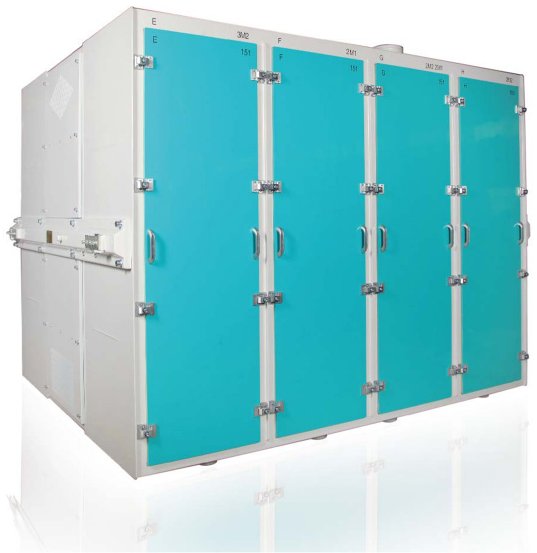
High Square Plansifter catalogue images
Photographs and parameter panels reproduced from the 2026 catalogue. Captions are the original brochure text.
Next step
Send your tonnage. Get a flow sheet in 12 working hours.
Send us: daily capacity target, wheat type and quality, available building dimensions, and local power supply. We reply within 12 working hours with a preliminary flow sheet, equipment list and budget range — no obligation.