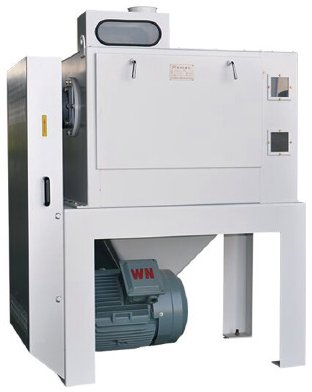
Final cleaning · Model TXFY / TXFL
Aspiration Separator
The last chance to pull chaff, beard and insect fragments out.
- 60+ years manufacturing
- 10–500 t/d capacity range
- 100+ patents
- Turnkey commissioning
What it does
Positioned immediately before the first break, the aspirator uses a light air stream to lift remaining light material out of the mill feed. It is cheap, it has almost no wearing parts, and it prevents contaminants from entering the milling system where they would be very difficult to remove.
Technical parameters
Nominal values at standard conditions. Confirm final specification on the order drawing.
| Model | Cleaning (t/h) | Pre-clean (t/h) | Air volume (m³/h) | Weight | Dimensions (mm) |
|---|---|---|---|---|---|
| TXFL80 | 12 | 50 | 2,800–3,000 | 230 kg | 860 × 2100 |
| TXFL100 | 16 | 65 | 3,500–3,800 | 360 kg | 1060 × 2150 |
| TXFL120 | 20 | 83 | 4,100–4,500 | 400 kg | 1260 × 2200 |
Selection guidance
Always fit one. The payback is not measured in capacity but in avoided customer complaints.
Maintenance
No wearing parts. Clean the air inlet grille weekly.
Selection cross-check
Air separation: cycling vs aspiration
Both use air to separate light impurities. The difference is whether the air is recirculated or drawn through once.
This machine
Aspiration Separator
TXFY / TXFL
Choose it when
Final cleaning before tempering, and anywhere you need the lightest possible aspiration duty with simple maintenance.
Watch out for
Once-through air must be filtered before discharge — the dust collector is part of the system cost, not an optional extra.
Alternative
Cycling Air Separator
TFXH
Choose it when
Where the plant is closed and dust emission must be minimal, or where the building is heated and you do not want to exhaust conditioned air.
Watch out for
Recirculated air picks up moisture and dust, so the separation efficiency drifts as the shift progresses. Needs a bleed-off and a filter.
Open Cycling Air Separator →Decision rule
Cycling air in cold or dust-sensitive plants; once-through aspiration where the dust collector already exists.
Answers
Frequently asked questions
Straight answers to the questions engineers and mill owners actually ask us during plant sizing. If your case is not covered, send the wheat specification and your target tonnage.
Ask an engineer →- Is an aspirator the same as a pneumatic conveyor?
- No. The aspirator uses air only to separate light material; it does not transport product. Pneumatic conveying is a separate system with much higher air volume and pressure.
From the brochure
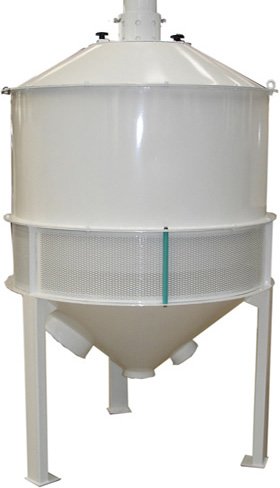
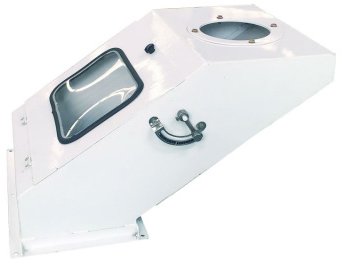
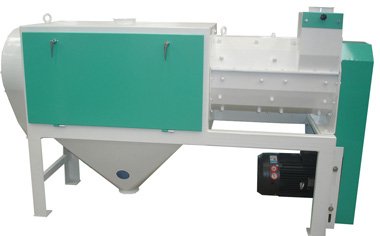
Aspiration Separator catalogue images
Photographs and parameter panels reproduced from the 2026 catalogue. Captions are the original brochure text.
Next step
Send your tonnage. Get a flow sheet in 12 working hours.
Send us: daily capacity target, wheat type and quality, available building dimensions, and local power supply. We reply within 12 working hours with a preliminary flow sheet, equipment list and budget range — no obligation.