Pillar handbook
Wheat Procurement and Storage Engineering for Flour Mills
How wheat selection, intake, storage and blending determine what your mill can physically produce — and the engineering decisions that must be made before the flow sheet is drawn.
Key takeaways
- Milling cannot create protein. Wheat selection sets the ceiling on every product you can sell.
- Storage capacity of 30–45 days of consumption is the practical minimum; below 20 days you buy at harvest peak prices and lose the spread.
- Aeration at 0.15–0.3 m³/min per tonne controls temperature; without it, a 60 t/d mill can lose a silo in three weeks.
- Blending to ±0.2% protein requires continuous proportioning, not batch mixing.
Every mill performance problem we are asked to diagnose eventually resolves to one of three things: the flow sheet, the maintenance, or the wheat. The first two are engineering problems with engineering answers. The third is a procurement problem, and it is usually decided before the first machine is ordered.
This handbook covers the part of a flour mill that sits between the weighbridge and the first break roll — and the commercial decisions that determine whether the plant can produce what its owner promised customers.
The order of decisions
A mill project moves through these gates in sequence. Skipping one costs more later than doing it now.
| Stage | Decision | Consequence if wrong |
|---|---|---|
| 1 | Product portfolio | Wrong flow sheet, wrong wheat, unsellable flour |
| 2 | Wheat specification | Cannot hit protein or ash; forced into import |
| 3 | Sourcing strategy | Working capital blowout, seasonal shutdown |
| 4 | Intake capacity | Trucks queue; harvest window missed |
| 5 | Storage capacity | Forced to buy at peak price |
| 6 | Cleaning and tempering | Extraction and ash both suffer |
| 7 | Blending system | Cannot hold specification between wheat lots |
Most projects start at stage 5 because that is where the visible equipment is. That is the wrong end.
Why wheat sets the ceiling
A mill cannot add protein, cannot remove ash below what the wheat allows, and cannot create gluten strength. It can only separate what is already there.
| Wheat protein | Best achievable product |
|---|---|
| 8.5–9.5% | Biscuit, cake, some pastry |
| 10.0–11.0% | Noodle, steamed bread, general purpose |
| 11.5–12.5% | Pan bread, standard bakery flour |
| 13.0–14.0% | Hearth bread, high-protein blends |
| 12.5–14.5% (durum) | Semolina, pasta |
If your market wants pan bread flour at 12.5% protein and your local wheat is 10.2%, you have three options: import high-protein wheat to blend, sell into a lower-protein market, or build a mill that cannot serve its customers. Only the first two are strategies.
What the source material establishes
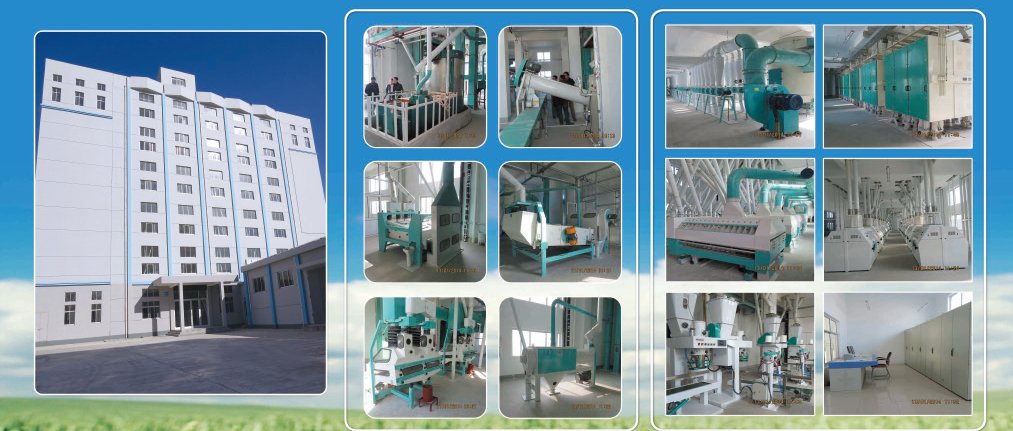
Haiyun plants run from 200 kg/h single units to 500 t/d turnkey installations. At the small end, wheat is bought by the bag or the truckload from neighbouring farms and stored in a corner of the building. At the large end — the 300 t/d Yengisar and 500 t/d Yuncheng plants — intake, storage and blending are a separate engineering discipline with its own equipment, its own building and its own capital line.
The difference between those two ends is not the mill. It is everything upstream of it.
Reading this handbook
The five articles below work through the sequence in order:
- Wheat classes and specifications — what to buy and how to write the contract
- Grain intake and weighing — how wheat physically enters the plant
- Silo design and aeration — how to store it without losing it
- Storage pest control — fumigation, monitoring and the legal constraints
- Blending strategy — how to hit a protein target every day
If you are at the feasibility stage, read them in that order. If you already operate a mill and are fighting inconsistent flour, start with blending — it is usually the cheapest fix.
The capital implication
Storage and intake are typically 12–20% of total plant capital, and they are the line item most often cut during value engineering. That cut is almost always paid back with interest:
| Item cut | Apparent saving | Real cost |
|---|---|---|
| Silo capacity halved | 6–9% of capex | Buys at peak price; 3–6% on wheat bill annually |
| Aeration omitted | 1–2% of capex | One spoiled silo wipes out the saving ten times over |
| Intake capacity cut | 2–3% of capex | Trucks queue at harvest; effective capacity falls |
| Blending system deferred | 3–5% of capex | Cannot hold protein spec; rejected loads |
A mill that cannot take wheat quickly, store it safely and blend it accurately will underperform its flow sheet no matter how good the rolls are.
What to send us
For a wheat-side design we need:
- Intended product list with protein and ash targets
- Local wheat availability by month, with typical analysis
- Whether import is permitted and at what duty
- Harvest calendar and the price spread between harvest and off-season
- Site access: truck size, turning circle, weighbridge position
- Available footprint for silos and the building height limit
With those we can size intake, storage and blending together with the mill — which is the only way the three numbers end up consistent.
Articles in this handbook
- → Grain Intake and Weighing: Sizing the Front Door of a Flour Mill
- → Silo Design and Aeration: Storing Wheat Without Losing It
- → Wheat Blending Strategy: How to Hit a Protein Target Every Day
- → Wheat Classes and Specifications: How to Write a Wheat Contract for a Flour Mill
- → Wheat Storage Pest Control: Monitoring, Fumigation and Residue Compliance