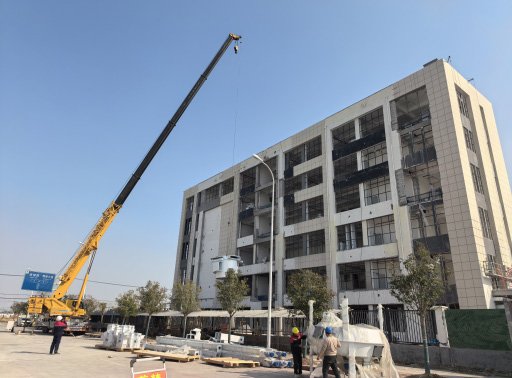
Turnkey — cold-climate design, supply, installation, commissioning · 2019
Beidahuang 200 t/d flour plant
A 200 t/d plant designed for −35 °C ambient: heated tempering bins, insulated conveying, enclosed intake and a building envelope rated for a Heilongjiang winter.
- 60+ years manufacturing
- 10–500 t/d capacity range
- 100+ patents
- Turnkey commissioning
Capacity
200 t/d
Installed power
690 kW
Design ambient
−35 °C
Flow sheet
4B5M
Tempering
Heated bins
Conveying
Insulated pneumatic
北大荒 200 吨面粉厂 · Beidahuang Reclamation Area, Heilongjiang, China
The brief
Beidahuang is a state reclamation area in northern Heilongjiang where winter ambient reaches −35 °C and stays below freezing for four to five months. The client needed a plant that runs through winter, not one that shuts down in November.
Standard flour mill design assumes tempering water at 15–25 °C and wheat entering the mill at ambient temperature. Neither assumption survives a Heilongjiang January.
What constrained the design
Four constraints that shaped the plant more than the capacity figure did.
Tempering water freezes
Tempering to 16.0% adds roughly 4 tonnes of water per 100 tonnes of wheat. At −35 °C, water on the wheat surface freezes before it can penetrate the kernel. The solution is to heat both the water and the wheat: tempering water at 30–35 °C, and wheat pre-warmed to above 5 °C before dampening.
Bin condensation
Warm, moist wheat entering a cold bin condenses on the walls, and the condensate freezes. Every tempering bin is insulated to 100 mm and trace-heated on the discharge cone. Bin walls are also fitted with differential temperature sensors, because a frozen cone stops discharge and the operator cannot see it.
Conveying heat loss
Pneumatic conveying lines run outside the heated envelope between buildings. Uninsulated, the air cools below the dew point and flour condenses in the line — which blocks it solid within a shift. All external runs are insulated and steam-traced.
Intake in snow
Trucks arrive with snow mixed into the wheat. The intake pit is fully enclosed and heated, and a snow-melting grid was added ahead of the drum sieve — an addition that came from a site visit in January, not from a specification document.
What was built
| Intake | Enclosed heated pit, snow grid, 25 t/h capacity, 60 t weighbridge under cover. |
|---|---|
| Cleaning | Single 12 t/h line, all equipment inside the heated envelope. Additional aspiration capacity because cold wheat is brittle and generates more dust. |
| Tempering | Four insulated bins with trace-heated cones, water heated to 30–35 °C, wheat pre-warmed through a heat exchanger on the intake conveyor. 20-hour minimum tempering time. |
| Milling | 4B5M on six FMFQ(S) double roller mills. Building envelope 40 × 8 × 18.5 m, insulated to 150 mm walls and 200 mm roof. |
| Sifting | Two FSFG high square plansifters, 44 m². Sifter room separately heated to hold 15 °C minimum. |
| Conveying | Insulated, trace-traced pneumatic lines for all external runs. Internal conveying mechanical. |
| Ventilation | Heat recovery ventilation — exhaust air passes through a plate exchanger to pre-warm incoming air. Recovers roughly 55% of ventilation heat loss. |
Measured outcome
The plant ran through its first winter without a cold-related stoppage. Internal temperature held at 12–18 °C in the milling floor at −32 °C ambient, at a heating cost of 3.1 kWh/t of wheat milled.
Tempering moisture accuracy was the key metric and held at ±0.25% — better than the standard ±0.3%, because pre-warming the wheat made water absorption more predictable than in a temperate-climate plant.
Total construction cost was 18% above a comparable temperate-climate plant. The client’s calculation was that four months of additional production per year paid that back in under three years.
What we would do differently
The honest section. Every project teaches something that was not in the specification.
- Cold-climate design is not a set of add-ons. It changes the tempering philosophy, the building envelope, the conveying routes and the intake layout. A temperate-climate design with insulation added is not a cold-climate plant.
- The snow grid came from a January site visit. No specification document would have produced it, and without it the drum sieve blinds within a week of snow arrival.
- Heat recovery ventilation was the highest-return single item in the project. It cost 2% of capital and returned 55% of the ventilation heat load every winter.
Next step
Planning a plant of this size?
Send us your target capacity, wheat specification and site constraints. We will tell you what a plant like this one would need — and what we would change if we built it today.