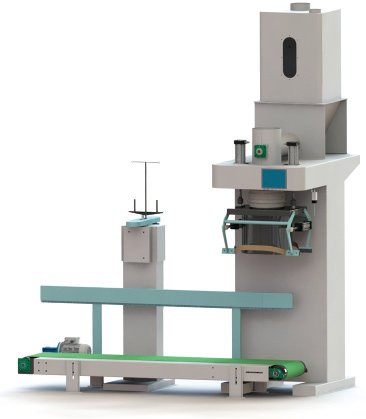
By-product recovery · Model FPDW / FBZD / KFS
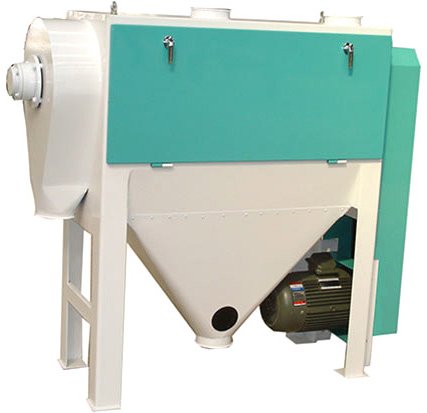
Bran Finisher
Recovers the flour that is stuck to the bran.
- 60+ years manufacturing
- 10–500 t/d capacity range
- 100+ patents
- Turnkey commissioning
What it does
Bran leaves the mill carrying 8–15% adherent flour. A bran finisher beats the bran against a screen to release it. On a 100 t/d plant the recovered material is worth more than the machine costs within the first year — it is the cheapest capacity you will ever add.
Technical parameters
Nominal values at standard conditions. Confirm final specification on the order drawing.
| Model | Drum dia. (mm) | Drum length (mm) | Speed (rpm) | Power | Capacity (t/h) | Weight | Dimensions (mm) |
|---|---|---|---|---|---|---|---|
| FPDW30×1 | 300 | 800 | 1300–1600 | 2.2 kW | 0.9–1.0 | 320 kg | 1270 × 480 × 1330 |
| FPDW30×2 | 300 | 800 | 1300–1600 | 2 × 2.2 kW | 1.8–2.0 | 640 kg | 1270 × 960 × 1330 |
| FPDW45×1 | 450 | 1100 | 1000–1100 | 5.5 kW | 1.3–1.5 | 500 kg | 1700 × 650 × 1620 |
| FPDW45×2 | 450 | 1100 | 1000–1100 | 2 × 5.5 kW | 2.6–3.0 | 1,000 kg | 1700 × 1300 × 1620 |
| FBZD4510 | 450 | 1000 | 1028 ± 10 | 5.5 kW | 1.5 | 520 kg | 1620 × 710 × 1550 |
| FBZD6012 | 600 | 1200 | 1028 ± 10 | 7.5 kW | 2.8 | 730 kg | 1820 × 810 × 1650 |
Selection guidance
Size on bran flow, not mill capacity. Bran is typically 22–28% of wheat intake, so a 60 t/d plant produces 14–17 t/day of bran across two shifts — one FPDW45×2 handles that comfortably.
Maintenance
Beater tips and screen cloth wear together; replace both, never one alone. Worn beaters against a new screen will shred it in weeks.
Selection cross-check
Bran recovery vs stock detachment
These two are often confused because both sit at the end of the milling section. They do different jobs and are not alternatives.
This machine
Bran Finisher
FPDW / FBZD
Choose it when
Whenever bran is sold as a by-product. Recovers adhering flour from bran, typically 1–3% of intake — which is 1–3 points of extraction that would otherwise leave the plant as low-value bran.
Watch out for
Over-aggressive finishing puts fine bran into the flour and raises ash. Screen condition is critical and needs weekly inspection.
Alternative
Impact Detacher
FSJZ / FSJQ
Choose it when
Between reduction passages where stock leaves the roll mill as flakes and agglomerates. Detaching before sifting lets the sifter do its job instead of screening lumps.
Watch out for
Excess speed or worn pins damage starch, raising starch damage and hurting biscuit and cake flours. It is a conditioning machine, not a grinder.
Open Impact Detacher →Decision rule
They are complementary, not alternatives: detachers go between rolls and sifters, bran finishers go after the last break. Fit both in any plant above 40 t/d.
Answers
Frequently asked questions
Straight answers to the questions engineers and mill owners actually ask us during plant sizing. If your case is not covered, send the wheat specification and your target tonnage.
Ask an engineer →- How much flour does a bran finisher recover?
- Typically 1.5–3% of mill intake — on 100 t/d that is 1.5–3 tonnes of saleable flour per day, which generally pays for the machine in under a year.
From the brochure
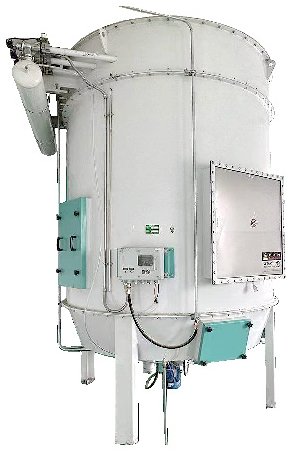
Bran Finisher catalogue images
Photographs and parameter panels reproduced from the 2026 catalogue. Captions are the original brochure text.
Next step
Send your tonnage. Get a flow sheet in 12 working hours.
Send us: daily capacity target, wheat type and quality, available building dimensions, and local power supply. We reply within 12 working hours with a preliminary flow sheet, equipment list and budget range — no obligation.